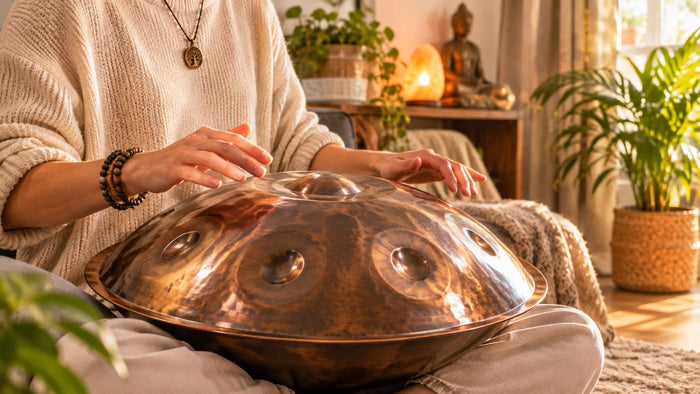
The handpan is one of the few musical instruments born in the 21st century. In barely twenty years, it has gone from a Swiss workshop to stages, yoga studios, and living rooms around the world. To understand where this very particular sound comes from, we have to go back a little further, to the Caribbean.
The roots: the steelpan of Trinidad and Tobago
It all starts with the steelpan, also known as the steel drum. In the mid-20th century, in Trinidad and Tobago, musicians transformed oil barrels into instruments. By hammering the metal, they created areas that each produce a precise note. The steelpan became the island's national instrument and traveled around the world.
The principle that would give birth to the handpan is already there: a thin sheet of steel, shaped and tuned by hand, where each area vibrates at its own frequency.
2000: the birth of the Hang in Bern
At the end of the 1990s, two Swiss luthiers, Felix Rohner and Sabina Schärer, had long been working on the steelpan in their PANArt workshop in Bern. They were looking for a more intimate instrument, played with the hands rather than with sticks.
In the early 2000s, they introduced the Hang ("hand" in Bernese German). Its shape is the one we know today: two glued steel half-shells, a domed central note on top, and an opening underneath. The sound immediately surprises with its softness and resonance.
From the Hang to the "handpan"
The Hang is made in small quantities and becomes very difficult to obtain. Faced with demand, other artisans started making instruments inspired by this principle. Since the name "Hang" belongs to PANArt, a new word appeared to refer to this family of instruments: the handpan.
Over the years, manufacturers multiplied in Europe, then America, and then Asia. Techniques progressed: new steels, more precise tuning, increasingly varied scales.
The anatomy of a modern handpan
Despite the evolutions, the structure remains faithful to the original idea:
- The ding: the central, domed note, often the lowest.
- The note fields: 7 to 9 notes arranged in a circle around the ding, sometimes more on the lower shell.
- The gu: the opening located under the instrument, which produces a bass note when struck and contributes to the resonance.
- The shell: two assembled steel hemispheres, often protected by a joint or a braided edge.
Why the handpan conquered the world
Several reasons explain this rapid success:
- It is accessible: all the notes of a handpan belong to the same scale. Even without musical training, you immediately produce something harmonious.
- Its sound touches everyone: rich in harmonics, both percussive and melodic, it evokes meditation, travel, and calm.
- It is easily shared: videos of musicians playing in nature or on the street have widely popularized the instrument on the internet.
The handpan today
The handpan is now played by professional musicians, wellness practitioners, teachers, and especially by thousands of amateurs looking for a simple and soothing instrument. From soft scales for meditation to more oriental scales for traveling, there is a handpan for every sensibility.
To learn more, discover how to choose the scale of your handpan, or the differences between handpan, Hang, steelpan, and tongue drum.
Velapan's advice: playing the handpan is continuing a story that is still very young. Choose an instrument whose sound touches you, and write the sequel your way. All our models can be listened to on the handpan collection.