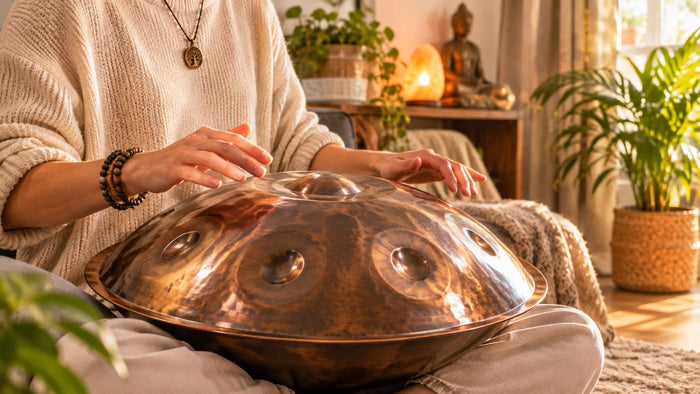
Many people discover the handpan during a yoga class, a relaxation session, or a video filmed in nature. This is no coincidence: its rich, resonant sound naturally invites you to slow down. Here is how to make it an ally in your moments of calm.
Why the handpan is so well suited to meditation
- There are no wrong notes: all the notes belong to the same scale. You can play without thinking, without fear of doing it wrong.
- The sound resonates for a long time: each note invites you to listen and wait for the next.
- The movement is repetitive and gentle: it helps you stay in the present moment, much like breathing.
Playing then becomes a form of active meditation: your attention settles on the sound, and your thoughts slow down.
Practice 1: breathing with accompaniment
- Get comfortable, with the instrument on your thighs.
- Inhale slowly through your nose for 4 counts.
- On the exhale, play the ding once and listen to the sound until it fades away.
- Repeat for 5 minutes.
This very simple exercise helps to pace your breath to a slow and regular rhythm.
Practice 2: slow playing
Choose three or four adjacent notes. Play them very slowly, in whatever order you like, always letting the previous sound fade before playing the next note. The goal is not to create a melody, but to listen to each vibration. Ten minutes are enough to feel a real change in your inner pace.
Practice 3: a shared sound bath
One person lies down with their eyes closed. Another plays gently beside them, alternating between low and high notes, without a fixed rhythm. This moment of sharing is highly appreciated among couples, families, or groups.
Which scale to meditate with?
Minor scales are often preferred for their gentleness: D minor Kurd, Celtic, Amara. Instruments tuned to 432 Hz are also highly appreciated for their slightly lower sound. To learn more, read 432 Hz or 440 Hz: what's the difference? and our article on the D minor Kurd scale.
Creating a ritual
- Choose a fixed time: in the morning when you wake up or in the evening before going to sleep.
- Leave your handpan visible, on its tripod: you will feel more like playing.
- Turn off screens, dim the lights, and give yourself 10 minutes.
The handpan is not a substitute for medical or psychological support, but many players find it to be a real moment of relaxation and refocusing in their daily lives.
Velapan's tip: meditation requires no technique. You can try these practices even on your first day. The tongue drum, with its very gentle sound, is also an excellent relaxation companion: discover the tongue drum collection.