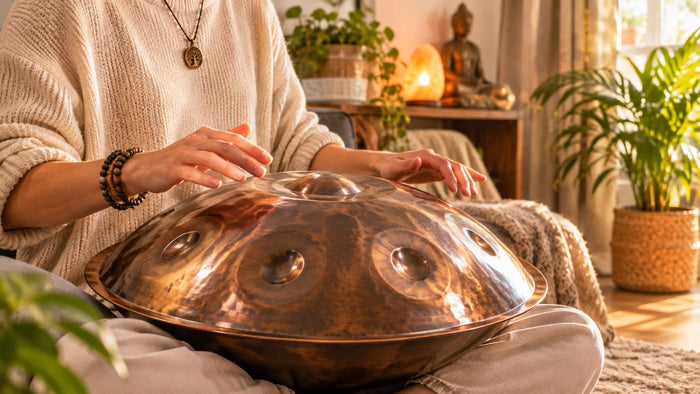
The handpan has a reputation for being an easy instrument, and it's true: you can produce a beautiful sound very quickly. But a few basic techniques make all the difference between a muffled note and one that sings. Here's how to get off to a good start.
Getting comfortable
Before playing, find a comfortable position. You have two options:
- Sitting with the instrument on your lap: the most common position. Place the handpan flat, with the opening (the gu) facing down, between your knees. A small cushion or support ring will prevent it from slipping.
- On a tripod: ideal for playing for long periods, standing or sitting on a chair. Keep your back straight and your shoulders relaxed.
In both cases, relax your shoulders and wrists. Tension is the number one enemy of a beautiful sound.
The right touch: bounce, don't strike
The key technique for the handpan is the bounce. The finger strikes the note and immediately pulls away, as if touching a hot surface. If the finger stays pressed down, it blocks the vibration and the note dies out.
- Strike with the pad of your finger or the tips of your index and middle fingers.
- Aim for the edge of the note, about a centimeter from its limit, rather than its center.
- Let the movement come from your wrist, with flexibility.
There's no need to strike hard. A light, quick movement makes the instrument sound much better than a heavy strike.
Playing the ding
The ding is the large central note, the lowest one. It is often played with the thumb, the palm, or several fingers together to produce a full, deep sound. It provides the pulse, much like a bass drum.
The notes in the circle
The notes around the ding are arranged in a zigzag pattern: the lowest one next to the ding, then going up by alternating left and right. Playing from the lowest to the highest note therefore creates a nice back-and-forth movement between your two hands.
First exercise: play the ding, then each note in the circle in order, one by one, letting each sound resonate. Listen. Repeat in reverse.
Percussive sounds
The handpan isn't just melodic. By tapping the shell between notes, lightly striking the edge, or muting a note with your palm, you can produce rhythmic sounds that enrich your playing. These "ghost notes" add groove to your pieces.
A 10-minute routine
- 2 minutes: the ding alone, trying to produce the roundest sound possible.
- 3 minutes: the scale going up and down, alternating hands.
- 3 minutes: a simple rhythm on two notes (see our article on basic rhythms).
- 2 minutes: free improvisation, without striving for perfection.
Playing a little every day is much better than one long session a week. Your fingers will memorize the movements, and the enjoyment will come very quickly.
Getting guidance
It is possible to learn on your own, but watching the techniques in a video helps enormously. That is why every Velapan handpan comes with a video course: 1 hour and 30 minutes of lessons in 9 chapters with Noah, your teacher, from the very first note to your first pieces.
Velapan tip: close your eyes while you play. Without looking at your hands, you will listen better to the sound, and your touch will naturally become lighter.